10 Reasons to Learn Church History (Part 2 of 10)

WhyRC2“Why would twenty-first century Christians—who can read the Bible for themselves and attend Bible-believing churches—need to study Church History?”

2. Learning church history will curb the arrogance of our present.

Some evangelicals could very well define “church history” as “the study of how everybody misinterpreted the Bible until we came along.” In fact, on several occasions I’ve heard people actually say, “I don’t care if I’m the first person in history to read the Bible this way. If that’s what Scripture says, then I’m going to accept it.” We should admire this confidence in Scripture, but that statement places a lot of unquestioned confidence in one’s own abilities to properly interpret the Bible. Don’t get me wrong. I believe in the sufficiency of Scripture, but I don’t believe in the sufficiency of self. The kind of arrogance that makes a person completely abandon the contributions from the past is what C. S. Lewis called “chronological snobbery,” which he defined as “the uncritical acceptance of the intellectual climate common to our own age and the assumption that whatever has gone out of date is on that account discredited. You must find why it went out of date. Was it ever refuted (and if so by whom, where, and how conclusively) or did it merely die away as fashions do? If the latter, this tells us nothing about its truth or falsehood.” (C. S. Lewis, Surprised by Joy: The Shape of My Early Life [San Diego: Harcourt Brace & Company, 1955], 207–8)

Grown men often look back over their lives and reflect on how far they’ve come and the progress they’ve made throughout. But poet Thomas S. Jones presents the opposite perspective: what if the younger version of me were to peer forward and see what kind of person I have become? He mused:

Across the fields of yesterday

    He sometimes comes to me,

A little lad just back from play—

    The lad I used to be.

And yet he smiles so wistfully

    Once he has crept within,

I wonder he still hopes to see

    The man I might have been.

Those words haunt me. I often wonder what the bygone generations of Christianity might think if they could peer “across the fields of yesterday” and see what had become of the faith for which they lived and died. I constantly ask myself, “If the church fathers or Protestant Reformers were to show up at my church, would they worship . . . or run?” Sometimes I see such a pitch of “chronological snobbery” in many of our avant-garde churches that I wonder if we would purposely drive them off . . . then brag about having done so!

Studying church history will help evangelicals understand their place in church history. It will help them see that their particular church tradition—with all its idiosyncrasies—is a flawed but valid part of something much bigger than themselves. They will realize that their present form of Christianity is itself a period that will one day be left in the distant past. They will be humbled by the moving testimonies, passionate ministries, and sacrificial devotion of the saints of old. The result? Church history will curb the arrogance of our present.

10 Reasons to Learn Church History (Part 1 of 10)

ancient path 3“Why would twenty-first century Christians—who can read the Bible for themselves and attend Bible-believing churches—need to study Church History?”

I’ve heard this kind of question phrased a number of ways over the years. Sometimes people ask it with a tone of sincere curiosity: Isn’t the Bible sufficient for all matters of faith and practice? Are those people from church history even relevant to our modern world? What can they tell us that isn’t already in the Bible for anybody with eyes to see and ears to hear?

Other times people ask with a tone of incredulity—even hostility: Won’t dwelling in the past keep us from looking to the future? Isn’t it dangerous to read all those Roman Catholics? Didn’t the church fall away from the Bible soon after the apostles? Don’t we believe in Scripture ALONE as the source of our theology?

As a professor of theology who has consciously injected a large dose of historical reflection into my biblical, doctrinal, and practical instruction, I’ve found it necessary to ready myself with a number of important reasons for looking into the rearview mirror of church history as we seek to drive forward into the future. I’d like to share with you ten reasons why every Bible-believing Christian should not merely give church history an occasional nod of respect, but embrace it as a critical component of a wise, balanced Christian life and ministry.

1. Learning church history will cure our ignorance of the past.  

Too many evangelicals are walking around in a constant state of what we might call duja vé. No, not déja vu—you know what that is: the odd feeling that this has happened before. Duja vé, on the other hand, is just the opposite: it’s that nagging feeling that none of this has ever happened before. The truth is, throughout the church’s history Christians have pretty much dealt with every kind of doctrinal and practical challenge you can imagine. Ecclesiastes 1:9–10 puts it this way: “What has been is what will be, and what has been done is what will be done, and there is nothing new under the sun. Is there a thing of which it is said, ‘See, this is new’? It has been already in the ages before us.”

Let me give an illustration. As a young believer, I was a member of a small community church in northern Minnesota. It was so small that the adult Sunday school class included everybody in the church except for the children and youth. As you might expect, in this mixed generation class intergenerational conflict sometimes flared up. On one occasion the subject of church music came up, centered on the question of the use of various instruments like guitars and drums. In our church only the piano was used in Sunday morning worship.

One older man in the class spoke up in a deep, gruff voice, ranting against the use of anything but the piano in worship and complaining about “that satanic beat” of modern music using drums. In his mind, using instruments associated with contemporary secular music would be selling out to “The Culture.”

But a little historical perspective would have helped here.

Most people who resist musical and instrumental changes to the worship service fail to acknowledge that every style of music and musical instrument has, at some point, been adapted from the surrounding culture. In fact, when great hymn writers like Isaac Watts and Charles Wesley wrote their now classic hymns, many church leaders rejected their songs because they believed Christians should sing only the inspired and inerrant Psalms. And instruments like the piano, violin, and even the organ were all initially rejected for Christian worship because of their associations with secular music.

Though the ignorance of the past illustrated in this particular example didn’t drive our church into controversy and conflict, other cases of ignorance of the past could potentially lead to disaster. In order for Christians to make wise decisions, they must be able to draw from a depth of historical knowledge. In short, learning church history will cure our ignorance of the past.

Sufficiency of the Five Senses: An Epistemological Problem for Non-Theistic Evolution?

If you had access to the external world only through the sense of smell, how would you perceive reality? Your entire universe would be nothing but a series of weak and strong odors; some pleasant, others putrid. If you encountered other beings in the universe, you would distinguish them only by their unique scents—if, that is, they had any discernible scent at all. A person with only the sense of smell may not have enough data to establish his or her own spatial or perhaps even temporal location; certainly they would have no concept of corporeality. In short, the sense of smell alone is insufficient for a being to construct a complete, accurate, or functional picture of the external world—or even one that is at least sufficiently close to complete, accurate, or functional.

Now what if a person only had the sense of hearing? The situation for such a person would only be slightly better than for the person granted the sense of smell alone. Instead of a series of odors, the hearing being would experience a string of loud and soft sounds, some pleasant to the ear, others harsh. Communication might be possible only if he or she could get control of the tongue and vocal chords without the sense of touch, and thus respond to sounds from others with his or her own sounds. Certainly, the hearing person would still have an incomplete, inaccurate, and poorly functional experience of the external universe.

The same thing can be said about all of the five senses—sight, smell, touch, taste, hearing. If any of these senses is missing, a person’s perception of the world would change. He or she may be able to function and communicate in the world, but the subjective experience of the external world would differ drastically from a person with all five senses.

Now, if I were a person with only the sense of hearing and I encountered another being who told me about his own sense of seeing, which I lacked, I would have no category within which to understand a concept like “sight.” Nor would I be able to understand ideas like bright, dark, red, or blue. A seeing being would have no way of explaining what my missing sensations were like, nor would I be able to imagine the kind of world such a person experiences. Though I could be made intellectually aware that I am deficient, I would have no way of knowing what that actually meant. Not really. I would, in fact, continue in my current state of perception as I always have.

If a person with, say, only three senses—the senses of touch, smell, and taste—endured for a lifetime without any knowledge that there were other senses available, that person would have no reason to think there were such things as sight and sound. A person with only these three senses may believe that three and only three senses are sufficient to grant him or her complete, accurate, and functional access to the external world. Such a person would, of course, be wrong, but left alone he or she would be unaware of the error.

Granted, modern humans have used technology to expand their ability to acquire data about the universe. Though hidden to our sight, we can detect infrared and ultraviolet light, radio waves, and radiation. We can examine tiny organisms as well as remote bodies through the use of microscopes and telescopes. But all of these forms of technology work within the existing five senses—enhancing and improving, not supplementing or adding to, the senses of sight, sound, taste, touch, and smell. These means of measuring otherwise invisible or inaudible things in our world have, indeed, altered the perception of reality for modern humans, but these means themselves depend entirely on our five senses. In a similar vein, theoretical physicists can hypothesize about the existence of numerous dimensions beyond those of our limited perspective, but in that case they have no way of imagining or experiencing such theoretical dimensions. They are aware of such possible dimensions through mathematical calculations and “picture” them through analogies and illustrations bound by experiences of their five senses. It is, in short, impossible to conceptually break from the constraints of the five scent perception of the external world.

This brings me to my point.

How can humans have any confidence that additional senses beyond our five would not radically alter our perception and experience of reality? If three senses are better than two, and four better than three, and five better than four, why wouldn’t six, seven, or eight be better than five? We cannot simply respond to such a question by saying, “I can’t imagine what those additional senses would be,” because a person who has only one could not imagine a second, and person with only two could not imagine a third.

So the question remains.

Could there be additional senses, which, if we had them, would radically alter the way we perceive and experience the external world? Would the hypothetical extra senses grant us access to a world similar to ours but more complete, fuller, deeper? As rational beings, we must acknowledge this possibility. But what about its probability?

This is where things get quite messy. Is it probable that we human beings have evolved the precise number of senses to completely and accurately perceive the world around us? Or is it probable that our sensory organs provide us with enough data to at least approximate reality? We know of small, primitive beings that do not possess the five senses we have, and people typically place such life forms into a category of less-evolved beings. But on what basis do we conclude that natural selection would develop five senses with a quality to provide an accurate perception of reality when their data are synthesized by the mind into a coherent whole?

The answer? From a purely naturalistic perspective, humans have no reasonable basis to have confidence that our five senses are sufficient. In fact, it seems more probable that naturalistic evolutionary processes would take the easiest route, as survival of the individual and propagation of the species—not epistemological accuracy—is the result of unguided evolution. Of course, we rational beings would naturally hope that our five senses were not merely all that was necessary for survival (functional sufficiency), but that they were adequate for providing a complete or nearly-complete experience of the external world (epistemological accuracy). While our five senses may provide a functional experience of reality sufficient for the purpose of survival, within a naturalistic view of evolution, our five senses cannot be trusted to provide an accurate (i.e., dependable) experience of reality.

However, I can posit an alternative understanding of the sufficiency of our five senses to provide an accurate or near-accurate experience of the external world. But for such a presupposition to be accepted, one must believe that human beings were designed for the purpose of accurately perceiving the external world, not merely evolved toward the function of survival and propagaion. If humans were designed to live in this particular universe, it is possible to believe that the designer equipped humans with no more and no less senses than are necessary to accurately perceive the external world. And depending on the character of that designer (good, powerful, truthful), one might conclude that such a presupposition about the ability of human beings to accurately experience the external world through their five senses is probable. Of course, a theist must acknowledge that there may be things in the world that go beyond what the designer intended for its creatures to perceive, but in any case the five senses would be sufficient to provide an accurate or nearly-accurate experience of the external world.

This brings me to my closing point. Any human being who believes that he or she possesses enough senses to draw confident conclusions about the external world on a daily basis is inherently drawing on the presupposition of intelligent design (whether evolutionary or non-evolutionary), not of naturalistic evolution. The former presupposition makes the sufficiency of the five senses a probable hypothesis; the latter presupposition does not. Apart from the hypothesis of an intelligent designer who equipped humans with the appropriate number and variety of sensory organs, the question of the sufficiency of the five senses for accurately experiencing the external world becomes, in my mind, an insurmountable problem. An atheist who appeals to evolution necessarily can have no epistemological confidence in his or her ability to adequately gather and to accurately analyze data about the world as it really is. The empirical sciences that form the foundation of their worldview seem to require a presupposition about the nature of sense perception that argues against their methods and conclusions. Only by appealing to an intelligent designer who equipped humans with sufficient senses for accurately experiencing the external world can a person reasonably engage in the empirical sciences.

[NOTE: Originally posts on July 9, 2008, at www.retrochristianity.com. For a more technical treatment of a similar argument as mine, see Alvin Plantinga, “Is Naturalism Irrational?” in The Analytic Theist: An Alvin Plantinga Reader, ed. James F. Sennett (Grand Rapids: Eerdmans, 1998), 72-96. I readily admit that my own popular expression of this argument differs from Plantinga’s in its expression, scope, and quality.]

“By This Time You Ought to Be Teachers”: A Critique of Typical Adult Sunday School

A couple of years ago, as I was reading through the book of Hebrews, I stumbled over a verse that forced me to reevaluate some key assumptions I had unquestionably inherited from my Bible church tradition: both the necessity and validity of adult Sunday school classes. The verse? Hebrews 5:12—“ For though by this time you ought to be teachers…” At that point I stopped. I thought about the audience to whom the author was writing. The book of Hebrews was written sometime around A.D. 65. The Jewish church—the probable audience of the book—was founded at about A.D. 35. So the believers addressed in Hebrews had been part of the faith for a maximum of thirty years (many of them less).

Having been believers for twenty to thirty years, the Hebrews ought to have been teachers, not students; experts, not novices; doers, not hearers; mature, not children (Heb. 5:13–14). The decades-old believers were expected to be training the younger believers in the “basic principles of the oracles of God”—the foundational doctrines of the faith contained in Holy Scripture (Heb. 5:12). They were expected to be skilled “in the word of righteousness,” passing on this skill to those who were yet unskilled (5:13). They were to be examples of discernment, able to lead the younger, less mature believers to “distinguish good from evil” (5:14). In short, they were to be the disciple-makers of the church, primarily engaged in teaching, not in learning.

After meditating on that passage, I thought about many Bible-adoring evangelical churches I had attended or visited over the years. Then it hit me. There are classes at my own church in which some of the members literally double the thirty-year mark of the book of Hebrews. Many more have been learners for fifty years, more for forty, plenty for thirty or twenty years. In such Bible-believing churches the function of those older saints is to show up Sunday mornings, plug into an adult Sunday school class, and build on their thirty years of Bible training. The goal of the adult education program is more Bible study with practical application for the believers’ lives—“The Bible as it is for people as they are.” The goal is not to equip those saints to teach younger believers in the church the elementary principles of the faith.

I wonder what the author of Hebrews would say if he were to critically evaluate the Sunday morning program of many of our churches. I wonder if he would say to half our adult classes, “By this time you ought to be teachers. Most of you have been believers for 25-plus years. What’s wrong with you? Will you ever step out of the role of unskilled novice and into the role of mentoring disciple-maker?” The model of church ministry defined in Ephesians 4 is pretty clear: The pastors and teachers of the church (those engaged in teaching and preaching) are to “equip the saints for the work of ministry.” Yet in many of our churches the teaching leads to knowledge and practical application—good things, but not quite ministry work specifically designed for “building up of the body of Christ.” Paul’s instructions to the pastor-teacher, Timothy, was to entrust the beliefs and practices of the church “to faithful men, who will be able to teach others also” (2 Tim. 2:2). Yet in many of our churches the teachers entrust the things of God to men and women who are not always themselves involved in any intentional disciple-making instruction. This isn’t true of everybody, of course. Some believers who grow in the faith do move into disciple-making ministries. But far too many get stuck in the rut of the eternal student, growing fat and sedentary in more and more biblical and doctrinal knowledge used only to enrich their own lives or the lives of their families.

So, what can we do to realign our adult Sunday school classes with a more biblical model of discipleship?

First, consider harmonizing Sunday school classes with the rest of the Sunday morning ministry of the church. Too often adult Sunday school classes become “mini-churches,” mirroring at a smaller scale what goes on in “big church.” They sometimes have mini-worship, mini-offerings, mini-sermons, and mini-prayer time. Then those same mini-church members shuffle on to big church where they get a more generalized version of the same activities. This is called redundancy. We need to rethink the role of the Sunday school in the overall vision and program of the church. If there are things that aren’t being done during Sunday worship, they should be done during Sunday school, and vice versa. The normal Sunday morning worship should include Scripture reading, teaching, and preaching from the pulpit that substantially nourishes the faith of growing believers in the church. This pulpit ministry should be the primary biblical exposition and practical exhortation for all members of the church. If the pulpit is functioning this way, then Sunday school should strive to do something that complements this pulpit ministry, not competes with it.

Second, consider grouping adult Sunday school classes by spiritual maturity, not physical age. The New Testament distinguishes the spiritually mature in Christ from “infants” or “children” in Christ (Eph. 4:14, 15; 1 Cor. 3:1; 13:11; 14:20; Heb. 5:12–14). The young in the faith are to be engaged in “basic training,” learning the fundamentals of the faith, the story of Scripture, and the basics of Christian living. Some of this initial training should occur prior to baptism and admission into membership in a local church; some should occur in the first several years of a believer’s new-found faith. Yet this training should be deliberately geared for the spiritually young, regardless of physical age. After passing through spiritual grade school and graduating from spiritual high school, believers should be headed toward honing their spiritual gifts to engage in a body-building ministry of the church. In other words, after a certain period of time, believers should transition from a mentee role in the church to a mentor role, from student to teacher. Of course, believers will always need intimate fellowship, accountability, and additional training. But at some point early in the Christian life, the maturing believer should be weaned from their dependency on constant instruction, and they should get their spiritual nourishment from the church’s pulpit ministry and from personal Bible reading. In a discipleship model, sixty-year-old Christians have no business being in a “senior adult class” taught by expository teachers unless they are still “children” in the faith who need to learn for the first time Scripture, doctrine, and Christian living.

Third, consider restoring a simple structure of beginners’ classes for new or young believers, ministry training for growing believers, and leadership training for mature believers. Regardless of whether Sunday school classes are divided into age groups, each one should be dedicated to one of these three body-building tasks of the church. 1) Beginners’ classes should be designed for those who have been believers for a short time or who have never formally experienced a “Christianity 101” kind of instruction. The emphasis of such classes should be rudimentary biblical content, essential doctrines of the Christian faith, and basic Christian living. Members of this class should typically be in the process of preparation for baptism or church membership. 2) New believers or newly-initiated members of the church should graduate to ministry training courses, regardless of their physical age. These classes should equip church members for evangelism, discipleship of believers younger than them in the faith (i.e., assisting in the classes under category 1), or participation in outreach or other ministries of the church. This training should involve not only biblical and theological truth, but also practical ministry experience—hearing and doing. 3) After many years of demonstrating faithful service in the ministry of the church, mature believers should be selected for leadership training—first as deacons, then as elders. Such training may involve formal education at an accessible Bible college or seminary, but it can also involve a specialized training program in the local church itself. Such preparation should include broad and deep biblical knowledge, systematic theology, church history, leadership skills, and training in teaching and preaching. Those in the early phases of this process would serve the church in the office of “deacon.” This process may take five to ten years, and only after such leadership training and service should believers submit to an ordination examination and appointment as pastors or “elders” of a local church.

Fourth, consider including short-term “elective” classes to meet special needs in the congregation. The changes suggested above in no way hinder a church from periodically or regularly offering special classes, conferences, or seminars dealing with biblical, doctrinal, historical, or practical issues. In fact, one should expect that such supplementary programs should be part of the normal teaching of the church. Marriage conferences, financial seminars, “refresher” courses on Bible doctrine, a series on church history, parenting classes, divorce recovery groups, a young married class—all of these can be offered on a short-term basis and taught or facilitated by members of the church involved in ministry training described above (category 2).

The author of Hebrews castigated his readers who had been believers for twenty-plus years because by that time they should have been teachers (Heb. 5:12). I’m concerned that many of our Bible-believing churches have failed to graduate their long-time believers from the status of student to that of teacher. Instead, they have institutionalized a model of adult Sunday school designed to perpetuate a nursery of needy spiritual children without transitioning them into responsible, mature, and productive spiritual adults. If we consider the four suggestions above, our churches will begin to reflect the biblical emphasis on discipleship rather than the cultural emphasis on personal enrichment.

[Originally posted at www.retrochristianity.com March 24, 2012.]


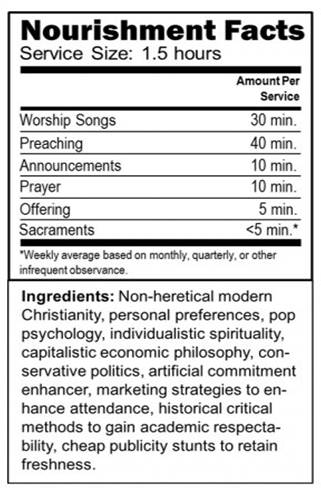
Peanut Butter Christianity: Is Yours a Cheap Imitation . . . or the Real Thing?

One day my wife sent me to the store to buy peanut butter—specifically, natural peanut butter. In other words, no fake stuff. This seemed simple enough . . . until I arrived in what looked like the peanut butter department of the grocery store. I suppose managing that aisle alone must be a full-time job. The options overwhelmed me—creamy, chunky, extra chunky, honey-flavored, jelly-filled, low fat, organic—and countless sizes, shapes, brands, and prices! My head spun.

There I stood, paralyzed with indecision, wanting nothing more than to snatch the cheapest jar of peanut butter and dash for the checkout. Instead, showing due diligence, I searched for “natural peanut butter” amidst the flashy brand names that virtually called out from the shelves like brochure pushers on the Vegas Strip: “Pick me! Pick me! Don’t you remember all those commercials you saw as a kid? All those smiling faces? Those cool special effects showing golden roasted peanutsmagically spread into smooth, creamy peanut butter?”

Lured by the flashy labels, my eyes landed on one popular brand paired with the keyword “Natural.” How convenient!

I grabbed it from the shelf.

I felt rather victorious until I got home and took a closer look at the back label. I then discovered that “natural” peanut butter isn’t necessarily a literal description. That particular brand of natural peanut butter did include roasted peanuts, of course. But it also contained sugar, palm oil, and salt. So that’s what we mean by natural? Really? All those things naturally grow on a peanut plant? I guess from one perspective these ingredients are natural as opposed to, say, “supernatural.” And at least I couldn’t find any unpronounceable ingredients like monosodiumtriglyceraticidipropylol. And to be fair to that brand, if we were to compare its ingredients to that peanut butter-like substance found in the candy aisle of a grocery store, that jar of peanut butter looked like pure gold.

But is junk food peanut butter really the standard? When I contrast that version of natural with a different, lesser-known brand’s natural peanut butter, I’m a little less forgiving. The ingredients lists for several others simply say, “Peanuts.” No salt, no oil, no emulsifier, no sweetener, no chemicals added to preserve freshness or enhance flavor. Just plain peanuts. Call me naïve, but to me, that’s natural whether we like how it tastes or not. Shouldn’t peanut butter made of just puréed peanuts serve as the standard for what constitutes natural peanut butter?

Over the next couple of weeks, as my mind periodically returned to the out-of-control peanut butter situation, something struck me. The failure of most peanut butters to actually live up to the natural standard reminds me of the out-of-control state of much of what is happening in contemporary evangelicalism. If I were to liken authentic, classic Christianity to the truly natural form of undiluted, unmixed, real peanut butter, then the multiple forms of evangelicalism that diverge more and more from this standard become, well, less and less authentic.

What I’m suggesting is this: over the last several decades, many of us evangelicals have become increasingly accustomed to a less “natural” form of Christianity. While still essentially Christian, many aspects of evangelicalism have become victims of “enrichment” by non-Christian ingredients that are meant to enhance the faith. This “enrichment” has been done to make the gospel more convenient, palatable, or marketable. Yet as these added ingredients take up more and more space, the essentials of the faith are necessarily displaced.

Take a stroll with me through the virtual aisles of our evangelical subculture—gift shops, radio stations, television programs, websites, even many of the new, trendy churches. We find ourselves surrounded by positive thinking, self-help, and behavior modification. We’re lured in by self-esteem best-sellers, do-it-yourself Christianity, and countless authors presenting the spiritual life as an ascending ladder: seven steps to this, three keys to that, the one prayer that will revolutionize your world, expand your influence, fulfill your desire for happiness. Let’s just be honest. Much of the garbage stinking up the shelves of Christian bookstores is passed off as Christian Living, but it’s mostly psychobabble or practical proverbs no better than what we find in the secular self-help or generic spirituality sections of our online bookseller.

Modern evangelical Christians who have become accustomed to this trendy, diluted form of Christianity have all but forgotten what the pure faith actually tastes like! In fact, many who are then exposed to a less adulterated faith—a form without all the unnecessary additives—find themselves actually disgusted by the original pure flavor of authentic Christianity, spitting it out and rejecting it as something foreign and inferior—or at least unpleasant to the palate.

The irony is that this purer form of Christianity is the authentic faith once for all delivered to the saints. The biblical gospel proclaimed, the sacraments rightly administered, discipline properly maintained, evangelism and discipleship emphasized, repentance and renewal preached—there is nothing really fancy about these things. In fact, they are so simple to identify and maintain that churches focusing on these fundamentals and freeing themselves from the frills appear to be washed-out has-beens or incompetent wannabes to most big-production glitz-and-glamour evangelicals.

Let’s return to the peanut butter aisle once again. We have to admit that all those peanut butter products do contain peanuts, and so they can genuinely be called “peanut butter.” Similarly, to varying degrees the marks of authentic Christianity are found in most of the products that fill the shelves of the evangelical church market. And to the degree that they retain those essential marks they are, in fact, Christian. Yet many forms of evangelical Christianity have been so colored with dyes, so mixed with artificial ingredients, or so drenched in candy coating that they are in danger of becoming cheap imitations that serve merely to distract from—not point to—the essential ingredients of the historical faith.

Just like additive-rich peanut butters that appeal to flavor rather than to nutrition, far too many evangelicals shop for me-centered feel-good church experiences rather than Christ-centered worship, discipleship, and authentic community. In fact, like sour-faced kids who reject all natural peanut butter, many evangelicals turn their noses away from authentic expressions of church and spirituality. They would rather keep dabbling in the artificial than adjust their tastes to the real thing.

In my book, RetroChristianity: Reclaiming the Forgotten Faith, I attempt to draw renewed attention to the original fount and purer streams of orthodox, protestant tradition that once fed evangelicalism’s spiritual reservoirs. And I’m not alone. Numerous evangelical leaders who have been submerged in biblical, theological, and historical reflection have sounded similar alarms and called for similar renewal. But most of these attempts at reorienting the evangelical masses—pastors, teachers, lay leaders, and church members—have been either ignored or unheeded by the masses.

It seems we’ve reached a point in the evangelical church market where it’s no longer enough to read just the front label. Now we have to focus on the fine print and see what place is given to the true marks of classic Christianity. The problem is, too few evangelicals are familiar enough with the original and enduring faith to sort the real from the fake. But it’s not too late! Every person who has reached this point in this essay has the opportunity—and the responsibility—to make a trip back to the shelves of competing flavors of Christianity, to return the poor product that has been pushed by ill-informed dealers, and to reclaim the forgotten faith for the future.

Label